Research-creation · computational arts · multispecies affect
POLYTOPE OF SYNTHETIC EMOTIONS
Corpus Hormē: affect between body, environment, and machine
Hrysovalanti Fereniki MaherasPhD Candidate, Digital MediaSchool of the Arts, Media, Performance & Design
What if emotion does not originate within the body, but emerges through its exchanges with the environment?
01 / PREMISE
Emotion is not contained.
Corpus Hormē treats affect as an embodied, relational, and environmentally contingent process. Heat, light, movement, sound, and atmosphere do not merely surround a body: they participate in its physiological state.
Emotion is therefore approached as a feedback process: environmental forces alter bodily conditions, those conditions shape perception and action, and movement creates a new relation with the environment.
Research question How can computational art reveal and engage the imperceptible biological processes involved in the synthesis of emotion across species?
Abstract
This research-creation investigates emotion as a distributed system formed through exchanges among bodies, environments, and technologies. Corpus Hormē translates environmental signals, physiological regulation, and adaptive movement into artificial-life behaviours and kinetic installation. By placing monarch environmental rhythms in dialogue with human endocrine regulation, the project asks how light, sound, motion, and code can make imperceptible affective processes spatially experienceable. Rather than reproducing recognizable emotions, it constructs conditions from which synthetic affect can emerge across biological and machine relations.
Corpus Hormē Kinetic wing study: a material interface for light, motion, and environmental response. Select the butterfly to play the video.
02 / BIOLOGICAL LENS
The monarch as model
The monarch’s body is read as an Umwelt: a world shaped through solar orientation, temperature, sensory feedback, hormonal regulation, and adaptive movement.
As an ectotherm, the monarch makes the body–environment relation especially perceptible. Available heat influences muscular readiness and flight, while light participates in orientation and migratory timing.
Monarch activity depends on a continuous coupling of body and surroundings. Ambient temperature helps determine when flight is physically possible; sunlight supplies both warmth and orientation cues; and sensory and internal regulatory processes shape direction, endurance, and seasonal movement. These relations offer a model of intelligence distributed across body, atmosphere, and time rather than located in a brain alone.
The project abstracts these dependencies into changing variables and feedback loops without claiming that a computational model can reproduce a monarch’s lived experience. The monarch instead provides a relational structure through which environmental dependence, physiological change, and adaptive action can be made perceptible.
Input solar radiation + ambient heat
Body sensory + physiological regulation
Action orientation + movement
Feedback changed environmental relation
03 / RELATIONAL SYSTEM
From environmental signal to synthetic affect
Choose a stage to trace the translation.
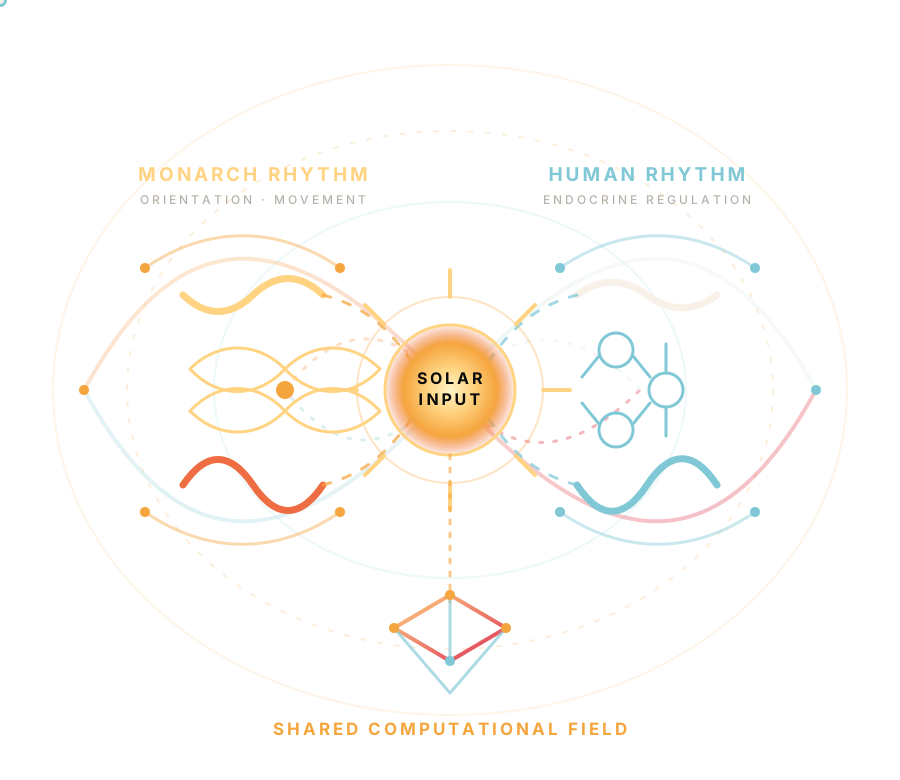
The process is recursive rather than linear. Environmental signals alter bodily state; bodily state conditions movement; movement generates new sensory information; and computational translation returns these relations as material behaviour.
04 / NON-INVASIVE METHOD
Observe → abstract → simulate → materialize
Observeenvironmental and movement relations
Abstractphysiological processes as dynamic variables
Simulatecross-species agents and feedback loops
Materializecomputed states as light, sound, and kinetics
Each translation preserves relationships rather than claiming a complete biological replica. Observed patterns become variables whose interactions can be tested, compared, and reconfigured through artistic experimentation.
Computer simulation replaces invasive experimentation with speculative, ethically driven modelling.
solar rhythm
hormonal flow
affective state
Cross-species bridge. Distinct monarch and human endocrine rhythms enter a shared computational field—not to equate the species, but to model relational principles.
05 / COMPUTATIONAL SYNTHESIS
Emotion becomes a relation.
Biochemical and neural processes are translated into interacting artificial-life agents. Their states emerge from exchanges rather than from fixed emotional labels.
Each agent carries changing internal variables, receives signals from other agents and the environment, and modifies its behaviour through feedback. Synthetic emotion is produced by the evolving organization of the whole system.
signal + memory + relation + feedback → emergent behaviour
06 / REALIZATION
Corpus Hormē becomes a polytope.
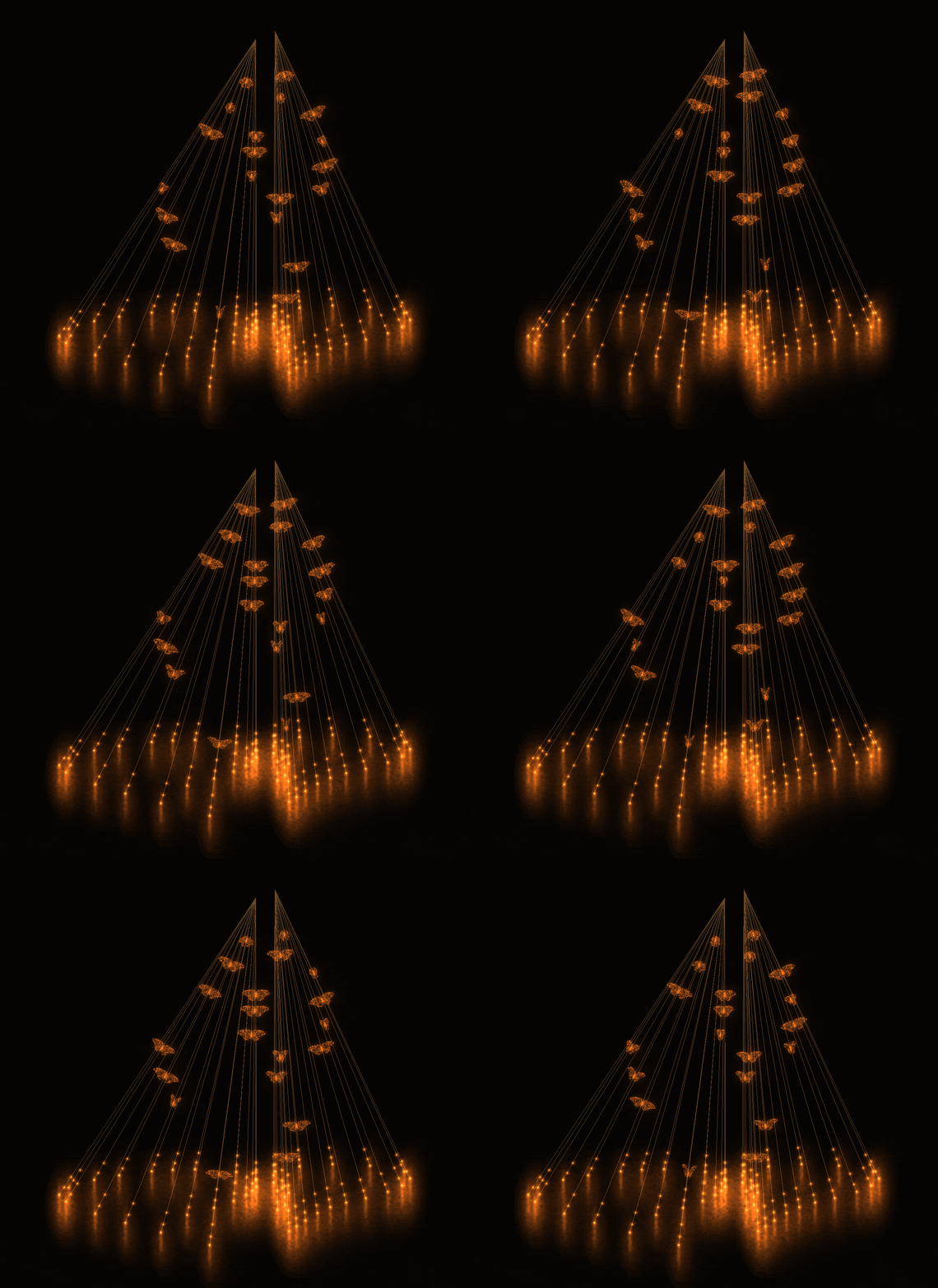
The butterfly sculpture is a kinetic interface within a larger transparent architecture. Programmable light translates hormonal flows; sound expresses neural transmission and feedback; suspended structures distribute those signals through space.
The installation does not represent a single human or monarch emotion. It gives spatial form to relations among bodies, environmental conditions, and computational agents, allowing audiences to encounter affect as an evolving collective field.
A transparent, multispecies architecture: a distributed emotional body made perceptible through light, sound, code, and motion.Scaffold study: an ephemeral room drawn by luminous vectors.